
Hydrophobic Compounds Method Transfer to Near UHPLC - AppNote
November 14, 2013
/
/
/
/
Separation of Hydrophobic Compounds by HPLC & UHPLC
This AppNote shows separation of analytes within a range of hydrophobicity. A simple gradient is used to elute all the compounds and baseline separation is obtained for the critical pair (peaks 4 and 5) and the least hydrophobic compound is adequately retained.
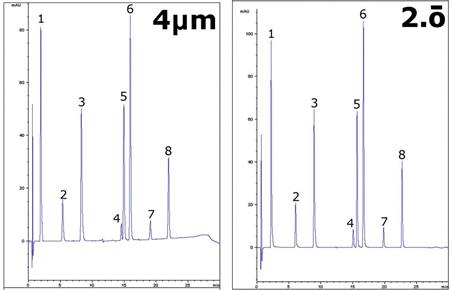
A comparison is shown in the figure below with a 4μm Cogent Bidentate C18 Column and a similar 2.o (2.2µm) Column. The retention profiles are quite comparable, meaning Method Transfer from one Column to the other will be easy to achieve.
Injection vol.: 1 µL
Flow rate: 0.3 mL / minute
Detection: UV @ 254 nm
Sample Preparation: Mixture of solutes in 80:20:0.1 Acetonitrile / DI Water / Formic Acid Diluent. Peak identities were confirmed with individual standards.
t 0 : 0.7 minutes

Attachment No 274 Transfer HPLC Method to UHPLC with Hydrophobic Compounds pdf 1 Mb Download File
This AppNote shows separation of analytes within a range of hydrophobicity. A simple gradient is used to elute all the compounds and baseline separation is obtained for the critical pair (peaks 4 and 5) and the least hydrophobic compound is adequately retained.
A comparison is shown in the figure below with a 4μm Cogent Bidentate C18 Column and a similar 2.o (2.2µm) Column. The retention profiles are quite comparable, meaning Method Transfer from one Column to the other will be easy to achieve.
Peaks:
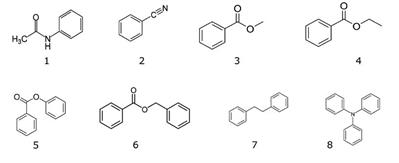
1. Acetanilide, 2. Benzonitrile, 3. Methyl Benzoate, 4. Ethyl Benzoate,
5. Phenyl Benzoate, 6. Benzyl Benzoate, 7. Bibenzyl 8. Triphenylamine
Method Conditions
Columns: Cogent Bidentate C18 2.o™, 2.2 μm, 120 Å; Cogent Bidentate C18™, 4 um, 100 Å
Catalog Nos.: 40218-05P-2; 40018-05P-2
Dimensions: 2.1 x 50 mm for both Columns
Mobile Phase:
--
A: DI Water / 0.1% Formic Acid (v/v)
--
B: Acetonitrile / 0.1% Formic Acid (v/v)
Gradient:
| Time (minutes) | %B |
|---|---|
| 0 | 20 |
| 1 | 20 |
| 25 | 80 |
| 26 | 80 |
| 27 | 20 |
Injection vol.: 1 µL
Flow rate: 0.3 mL / minute
Detection: UV @ 254 nm
Sample Preparation: Mixture of solutes in 80:20:0.1 Acetonitrile / DI Water / Formic Acid Diluent. Peak identities were confirmed with individual standards.
t 0 : 0.7 minutes
Attachment No 274 Transfer HPLC Method to UHPLC with Hydrophobic Compounds pdf 1 Mb Download File