
Diosmin, Eriocitrin and Naringin Glycosidic Flavonoids Analyzed with HPLC - AppNote
February 7, 2014
/
/
/
Separation of Diosmin, Eriocitrin, and Naringin
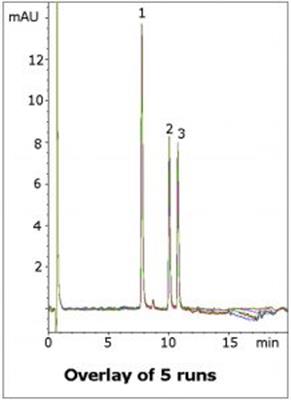
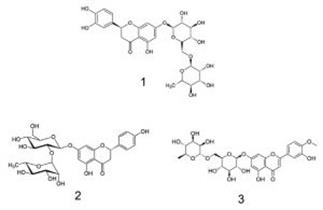
In this method, three Glycosidic flavonoid standards are separated with good resolution. The Cogent Bidentate C18 2.o™ Column produces high efficiency peaks with reproducible retention (see figure overlay). Separation is also observed for a small impurity peak, eluting between peaks 1 and 2. This separation of standards could be applied to more complex samples such as citrus fruit extracts.
Column: Cogent Bidentate C18 2.o™, 2.2 μm, 120 Å
Catalog No.: 40218-05P-2
Dimensions: 2.1 x 50 mm
Mobile Phase:
-- A: DI Water / 0.1% Formic Acid (v/v)
-- B: Acetonitrile / 0.1% Formic Acid (v/v)
Gradient:
Post Time: 3 minutes
Injection vol.: 0.2 μL
Flow rate: 0.3 mL / minute
Detection: UV @ 254 nm
Sample Preparation:
Stock Solutions: 1.0 mg / mL Diosmin in DMSO diluent
------------------------ 1.0 mg / mL Naringin in 1:1 DMSO : MeOH diluent
------------------------ 1.0 mg/ mL Eriocitrin in 1:1 DMSO : MeOH diluent.
Mixture: 0.02 mg / mL Diosmin,
-------------- 0.7 mg / mL Eriocitrin,
-------------- 0.2 mg / mL Naringin in 1:1 DMSO: MeOH diluent.
Note: Flavonoids are an important class of compounds found in citrus fruits. They have been shown to have anti-inflammatory, anti-allergic, anti-carcinogenic, antihypertensive and antiarthritic activities. Therefore, there is a need for a reliable HPLC method for their separation and quantitation.

Attachment No 292 Glycosidic Flavonoids pdf 0.4 Mb Download File
In this method, three Glycosidic flavonoid standards are separated with good resolution. The Cogent Bidentate C18 2.o™ Column produces high efficiency peaks with reproducible retention (see figure overlay). Separation is also observed for a small impurity peak, eluting between peaks 1 and 2. This separation of standards could be applied to more complex samples such as citrus fruit extracts.
Peaks:
1. Eriocitrin,
2. Naringin
3. Diosmin
Column: Cogent Bidentate C18 2.o™, 2.2 μm, 120 Å
Catalog No.: 40218-05P-2
Dimensions: 2.1 x 50 mm
Mobile Phase:
-- A: DI Water / 0.1% Formic Acid (v/v)
-- B: Acetonitrile / 0.1% Formic Acid (v/v)
Gradient:
| Time (minutes) | %B |
|---|---|
| 0-1 | 10 |
| 15 | 30 |
| 16 | 30 |
| 17 | 10 |
Post Time: 3 minutes
Injection vol.: 0.2 μL
Flow rate: 0.3 mL / minute
Detection: UV @ 254 nm
Sample Preparation:
Stock Solutions: 1.0 mg / mL Diosmin in DMSO diluent
------------------------ 1.0 mg / mL Naringin in 1:1 DMSO : MeOH diluent
------------------------ 1.0 mg/ mL Eriocitrin in 1:1 DMSO : MeOH diluent.
Mixture: 0.02 mg / mL Diosmin,
-------------- 0.7 mg / mL Eriocitrin,
-------------- 0.2 mg / mL Naringin in 1:1 DMSO: MeOH diluent.
Note: Flavonoids are an important class of compounds found in citrus fruits. They have been shown to have anti-inflammatory, anti-allergic, anti-carcinogenic, antihypertensive and antiarthritic activities. Therefore, there is a need for a reliable HPLC method for their separation and quantitation.
Attachment No 292 Glycosidic Flavonoids pdf 0.4 Mb Download File