Date: 16-MARCH-2015 Last Updated: 15-SEPTEMBER-2026
Introduction
Analysts are sometimes surprised to observe multiple peaks when analyzing a fructose standard or fructose-containing sample by HPLC. In many cases, these peaks do not indicate contamination, degradation, or the presence of impurities.
Instead, fructose naturally exists as a mixture of several molecular forms that remain in equilibrium in solution. Depending on the chromatographic method, stationary phase chemistry, mobile phase composition, and column temperature, these forms may be partially or fully resolved into separate peaks. Understanding the structural behavior of fructose is important when interpreting chromatographic results.
Why Fructose Can Produce Multiple Peaks
Unlike many compounds that exist predominantly as a single molecular structure, fructose can exist in several interconverting forms. These include:
- Open-chain fructose
- Fructofuranose forms (five-member ring structures)
- Fructopyranose forms (six-member ring structures)
- Alpha (α) anomers
- Beta (β) anomers
Because these structures possess slightly different three-dimensional configurations, they may interact differently with the stationary phase and produce separate chromatographic responses.
Fructose Exists as an Equilibrium Mixture
When fructose is dissolved in solution, a dynamic equilibrium is established between multiple structural forms. The equilibrium typically includes:
Open-Chain Form
The linear structure of fructose exists in relatively small amounts compared to the cyclic forms.
Fructofuranose Forms
These structures contain a five-member ring and can exist as:
- α-D-fructofuranose
- β-D-fructofuranose
Fructopyranose Forms
These structures contain a six-member ring and can exist as:
- α-D-fructopyranose
- β-D-fructopyranose
Each form possesses unique stereochemical characteristics that may influence chromatographic retention.
Structural Illustration
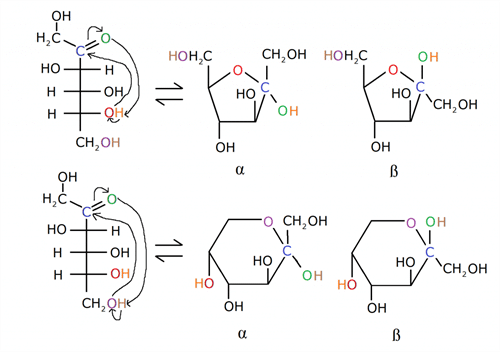
Multiple structural forms of fructose including the open-chain form, fructofuranose isomers, and fructopyranose isomers. These species exist in equilibrium in solution and may produce multiple peaks during chromatographic analysis.
Role of Anomers
Anomers are stereoisomers that differ only in the orientation of the hydroxyl group at the anomeric carbon. For fructose:
- α forms exist
- β forms exist
Although the difference appears minor from a structural perspective, chromatographic systems can often detect these differences. As a result, α and β anomers may produce separate peaks under suitable separation conditions.
Role of Ring Structures
Fructose can also exist as different ring sizes. The two primary cyclic forms are:
- Fructofuranose (five-member ring)
- Fructopyranose (six-member ring)
These forms possess different molecular shapes and spatial arrangements. Because chromatography is sensitive to molecular structure, these ring forms can contribute to additional retention differences and peak splitting.
Factors That Influence Peak Resolution
Whether multiple fructose forms appear as distinct peaks depends on several chromatographic variables. These include:
- Stationary phase chemistry
- Mobile phase composition
- Column temperature
- Flow rate
- pH conditions
- Detector sensitivity
Some methods may produce a single broad fructose peak, while others may separate several individual forms.
Is This a Problem?
In many cases, the appearance of multiple fructose peaks is completely normal. Multiple peaks are not necessarily evidence of:
- Sample contamination
- Degradation
- Method failure
- Impurities
Instead, the chromatogram may simply be resolving naturally occurring structural forms present in the fructose solution. Proper peak identification should be performed before assuming that additional peaks represent contaminants.
Applications Where This Is Common
Multiple fructose peaks may be observed in:
- Carbohydrate analysis
- Food and beverage testing
- Metabolomics studies
- Biological samples
- Sugar profiling methods
- Research involving monosaccharides
These applications often involve chromatographic methods capable of distinguishing subtle structural differences among sugar molecules.
Method Development Considerations
When analyzing fructose:
- Consider the possibility of multiple naturally occurring forms.
- Verify peak identification using standards.
- Maintain consistent mobile phase conditions.
- Control temperature where possible.
- Understand the selectivity of the stationary phase being used.
These practices can help prevent misinterpretation of chromatographic data.
Conclusion
Multiple peaks observed during fructose analysis are often the result of naturally occurring α and β anomers as well as fructofuranose and fructopyranose ring forms. Because fructose exists as an equilibrium mixture of several structural species in solution, certain HPLC methods are capable of resolving these individual forms into separate chromatographic peaks. Understanding this behavior can help analysts correctly interpret results and avoid confusing normal fructose chemistry with contamination or sample degradation.