Date: 12-JANUARY-2026 Last Updated: 11-SEPTEMBER-2026
Overview
When a method specifies a filter pore rating—such as 0.2 µm—it is referring to a nominal pore size classification, not a precise and absolute pore diameter. Filter membranes are produced with a distribution of pore sizes, and manufacturers assign ratings based on statistical performance, integrity testing, and industry standards. Because the distributions for 0.2 µm and 0.22 µm membranes significantly overlap, filters labeled 0.22 µm are widely accepted as suitable substitutes for methods specifying 0.2 µm—especially when the performance requirement is based on validated retention (e.g., microbial retention claims) rather than an exact pore dimension.
Understanding Pore Size and Porosity
Filtration membranes have thousands to millions of pores with natural manufacturing variation. Key points:
- Pore size = nominal classification, derived from membrane characteristics and testing
- Porosity = the percentage of open volume, contributing to flow rate and throughput
- Pore size distribution shows the range of pore diameters across the membrane
In practice, this means a membrane labeled 0.2 µm may have some pores slightly smaller or larger—but its overall performance meets the criteria established for that rating.
0.2 µm vs. 0.22 µm: Why They Are Considered Equivalent
Although the numbers appear different, both values represent the same nominal pore class:
- 0.22 µm filters are engineered to fulfill the same expectations normally required for membranes labeled 0.2 µm
- They undergo similar integrity testing, including bubble point and microbial challenge requirements
- Regulatory and analytical methods often treat them interchangeably when based on validated performance, not numeric labeling
Therefore, a 0.22 µm filter will almost always satisfy method requirements that call for a “0.2 µm filter,” unless the method explicitly states that the printed pore rating must match.
Practical Guidance for Method Execution
When a method specifies 0.2 µm, the following applies:
- A 0.22 µm filter is within the same nominal pore class
- It should meet the method’s performance requirements when:
-
- microbial retention criteria are based on validation,
- pore-size equivalency has been demonstrated,
- integrity tests fall within acceptable limits
- Always check customer, regulatory, or SOP requirements if wording explicitly restricts substitution (“must be labeled 0.20 µm”).
When in doubt, confirm with the QA group or method owner.
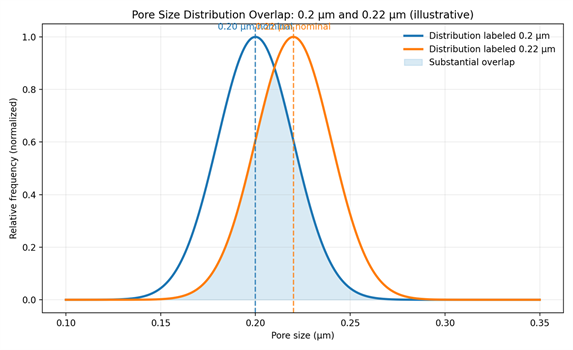
Illustration: Pore Size Distribution Overlap
A typical pore-size distribution graph for 0.2 µm and 0.22 µm membranes shows large overlapping regions. This overlap demonstrates why both pore ratings are considered part of the same functional class.
Conceptual interpretation:
- The “peaks” in each curve represent the most common pore diameters
- Both distributions fall within the expected nominal range
- Small differences in labeling do not indicate meaningful performance differences
This is why laboratories confidently use 0.22 µm filters for methods originally written for 0.2 µm devices.
When Exact Pore Size Labeling Matters
Certain environments may require strict adherence to labeling, including:
- Good Manufacturing Practice (GMP) SOPs
- Customer‑mandated specifications
- Regulatory filings with fixed language
- Methods that require documentation matching exact printed ratings
In these cases, the method must be followed precisely—even if functional equivalency exists.