
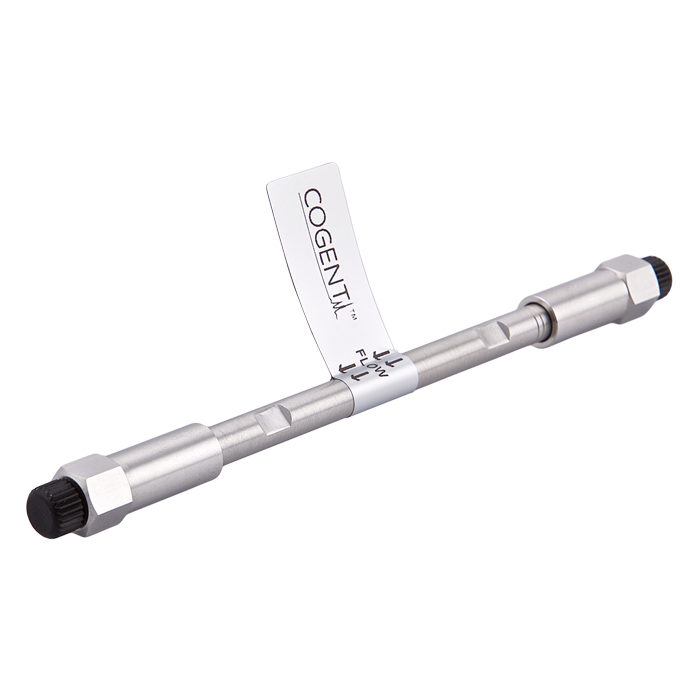
Metabolomics Development Kit, 2x100. 1 Cogent Diamond Hydride™ & 1 Cogent Bidentate C18™. Cogent TYPE-C Brand. 1 PK.
Additional Information:
The 43000‑10P‑2 Metabolomics Development Kit provides an economical, application‑focused pairing of two widely used TYPE‑C™ silica hydride HPLC columns for LC‑MS‑based metabolomics and small‑molecule profiling. This kit includes one Cogent Diamond Hydride™ HPLC Column and one Cogent Bidentate C18™ HPLC Column, enabling direct comparison of HILIC‑style and reversed‑phase separations using matched column geometry.
Both columns are manufactured with Cogent TYPE‑C™ silica hydride technology, offering fast equilibration, robust performance, and reproducible retention across a wide range of LC‑MS methodologies.
Kit Composition
This development kit contains two analytical HPLC columns:
Shared specifications for both columns:
Internal Diameter: 2.1 mm
Length: 100 mm
Particle Size: 4 µm
Pore Size: 100 Å
Stationary Phase Platform: Cogent TYPE‑C™ silica hydride
Using identical dimensions and particle architecture allows meaningful method‑development comparisons without introducing geometric or pressure‑related variables.
Application Focus: Metabolomics & LC‑MS Method Development
The two stationary phases in this kit provide complementary retention mechanisms that collectively span a wide portion of the metabolome:
Cogent Diamond Hydride™
HILIC‑style retention on a stable silica‑hydride surface
Strong retention of highly polar metabolites
Fast equilibration and excellent LC‑MS compatibility
Cogent Bidentate C18™
Reversed‑phase retention with dual‑point C18 attachment
Improved stability versus conventional bonded C18 phases
Effective for less polar and hydrophobic metabolites
Together, these columns support broad metabolite coverage using a unified TYPE‑C™ surface chemistry.
Why Choose the 2.1 mm × 100 mm Format
The 2.1 mm ID × 100 mm length is frequently selected when greater resolving power than 50 mm columns is required, while retaining solvent efficiency:
Higher peak capacity for complex samples
Improved separation confidence for closely eluting metabolites
Reduced solvent consumption compared to 4.6 mm ID columns
Well suited for routine and exploratory LC‑MS workflows
The 4 µm particle size favors robust, repeatable operation on standard analytical and LC‑MS systems without the pressure demands of sub‑2 µm formats.
System Requirements and Flow Rates
Typical flow range (2.1 mm ID): ~0.2–0.3 mL/min
Compatible with standard analytical HPLC and LC‑MS systems capable of stable low‑flow delivery
Flow‑rate and gradient conditions should be optimized based on mobile‑phase composition, temperature, and system pressure limits.