
Xanthine, Uric Acid and Hypoxanthine Analyzed with LC-MS - AppNote
May 10, 2012
/
/
/
/
Separation of Biomarkers found in Human Fluids
A simple Method was developed for the determination of Xanthine (X), Uric Acid (UA), and Hypoxanthine (HX) at concentrations in human urine (can be used for human serum) to support pharmacodynamic (PD) studies of a novel Xanthine Oxidase inhibitor during its clinical development.
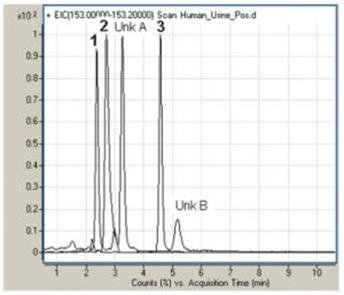
PD Biomarkers (UA, X, and HX) were well separated from each other. In addition Xanthine was separated from two isobaric unknowns (unknown A and B) present in this particular urine sample. Current HPLC Methods for UA / X / HX measurements suffer from low Sensitivity, poor Selectivity, and/or inefficient sample throughput. The developed method is Fast and Sensitive and it will allow high sample throughput.
Column: Cogent Diamond Hydride™, 4 µm, 100 Å
Catalog No.: 70000-10P-2
Dimensions: 2.1 x 100 mm
Mobile Phase:
Post Time: 5 minutes
Flow rate: 0.4 mL / minute
Detection: ESI – pos - Agilent 6210 MSD TOF Mass Spectrometer.
Sample Preparation: 400 µL of Acetonitrile was added to 100 µL of human urine and sample was centrifuged (3000 g). Next, 20 µL of the supernatant was mixed with 10 µL of the 50:50 Acetonitrile / DI Water / 0.1% Formic Acid.
Notes: Xanthine Oxidase, an enzyme which catalyzes the oxidation of Hypoxanthine (HX) to Xanthine (X) to Uric Acid (UA) can be inhibited by allopurinol and other drugs. Uric acid lowering drugs are used in the treatment of gout and the prevention of tumor lysis syndrome. High concentrations of UA in blood (hyperuricemia) cause deposition of urate crystals, which could ultimately result in chronic joint inflammation and renal impairment. The determination of UA has been one of the tests in the clinical chemistry laboratory performed for patient diagnosis of gout.

Attachment No 96 Xanthine, Uric acid & Hypoxanthine Analyzed with LCMS pdf 0.2 Mb Download File
A simple Method was developed for the determination of Xanthine (X), Uric Acid (UA), and Hypoxanthine (HX) at concentrations in human urine (can be used for human serum) to support pharmacodynamic (PD) studies of a novel Xanthine Oxidase inhibitor during its clinical development.
PD Biomarkers (UA, X, and HX) were well separated from each other. In addition Xanthine was separated from two isobaric unknowns (unknown A and B) present in this particular urine sample. Current HPLC Methods for UA / X / HX measurements suffer from low Sensitivity, poor Selectivity, and/or inefficient sample throughput. The developed method is Fast and Sensitive and it will allow high sample throughput.
Peaks:
1. Xanthine (X)
153.04070 m/z
2. Uric Acid (UA)
169.03560 m/z
Unknown A
153.06080 m/z
3. Hypoxanthine (HX)
137.04580 m/z
Unknown B
153.06606 m/z
Column: Cogent Diamond Hydride™, 4 µm, 100 Å
Catalog No.: 70000-10P-2
Dimensions: 2.1 x 100 mm
Mobile Phase:
- A: DI Water / 0.1% Formic Acid
- B: Acetonitrile / 0.1% Formic Acid
| Time (minutes) | %B |
|---|---|
| 0 | 95 |
| 0.2 | 95 |
| 8 | 80 |
| 9 | 80 |
| 10 | 50 |
| 12 | 50 |
Post Time: 5 minutes
Flow rate: 0.4 mL / minute
Detection: ESI – pos - Agilent 6210 MSD TOF Mass Spectrometer.
Sample Preparation: 400 µL of Acetonitrile was added to 100 µL of human urine and sample was centrifuged (3000 g). Next, 20 µL of the supernatant was mixed with 10 µL of the 50:50 Acetonitrile / DI Water / 0.1% Formic Acid.
Notes: Xanthine Oxidase, an enzyme which catalyzes the oxidation of Hypoxanthine (HX) to Xanthine (X) to Uric Acid (UA) can be inhibited by allopurinol and other drugs. Uric acid lowering drugs are used in the treatment of gout and the prevention of tumor lysis syndrome. High concentrations of UA in blood (hyperuricemia) cause deposition of urate crystals, which could ultimately result in chronic joint inflammation and renal impairment. The determination of UA has been one of the tests in the clinical chemistry laboratory performed for patient diagnosis of gout.
Attachment No 96 Xanthine, Uric acid & Hypoxanthine Analyzed with LCMS pdf 0.2 Mb Download File