
Terbutaline and Salbutamol Analyzed by HPLC - AppNote
November 12, 2012
/
/
/
Separation of ß2-Adrenergic Receptor Agonists
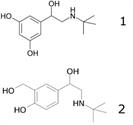
This Method shows how two structurally similar compounds can be readily separated. This is an important characteristic in many types of HPLC Methods since typical separations often involve impurities, degradants, metabolites, and other groups of compounds that have subtle structural differences. These two compounds for instance were found to coelute using Reversed Phase approaches.
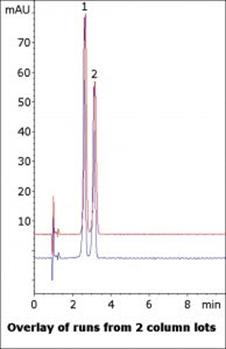
The Method shown here is simple and the Isocratic Mobile Phase is easy to prepare. Baseline resolution is obtained for the two compounds. Furthermore, the Method reproducibility is good, as shown in the figure which uses Columns from two different lots.
Column: Cogent Diamond Hydride™, 4 μm, 100 Å
Catalog No.: 70000-7.5P
Dimensions: 4.6 x 75 mm
Mobile Phase: 5% DI Water / 95% Acetonitrile / 0.1% Trifluoroacetic Acid (TFA) v/v
Injection vol.: 2 μL
Flow rate: 1.0 mL / minute
Detection: UV @ 220 nm
Sample Preparation: 0.1 mg / mL Terbutaline and Salbutamol reference standards in diluent of 50:50 0.1 DI Water / Acetonitrile / Trifluoroacetic Acid (v/v).
t 0 : 0.9 minutes
Note: Salbutamol and Terbutaline are ß2- Adrenergic receptor agonists used for treatment of asthma and pulmonary diseases. Salbutamol is available under the trade name Ventolin®. Trade names for Terbutaline include Brethine®, Bricanyl®, and Brethaire®.

Attachment Terbutaline and Salbutamol Analyzed by HPLC pdf Download File
This Method shows how two structurally similar compounds can be readily separated. This is an important characteristic in many types of HPLC Methods since typical separations often involve impurities, degradants, metabolites, and other groups of compounds that have subtle structural differences. These two compounds for instance were found to coelute using Reversed Phase approaches.
The Method shown here is simple and the Isocratic Mobile Phase is easy to prepare. Baseline resolution is obtained for the two compounds. Furthermore, the Method reproducibility is good, as shown in the figure which uses Columns from two different lots.
Peaks: 1. Terbutaline, 2. Salbutamol
Method ConditionsColumn: Cogent Diamond Hydride™, 4 μm, 100 Å
Catalog No.: 70000-7.5P
Dimensions: 4.6 x 75 mm
Mobile Phase: 5% DI Water / 95% Acetonitrile / 0.1% Trifluoroacetic Acid (TFA) v/v
Injection vol.: 2 μL
Flow rate: 1.0 mL / minute
Detection: UV @ 220 nm
Sample Preparation: 0.1 mg / mL Terbutaline and Salbutamol reference standards in diluent of 50:50 0.1 DI Water / Acetonitrile / Trifluoroacetic Acid (v/v).
t 0 : 0.9 minutes
Note: Salbutamol and Terbutaline are ß2- Adrenergic receptor agonists used for treatment of asthma and pulmonary diseases. Salbutamol is available under the trade name Ventolin®. Trade names for Terbutaline include Brethine®, Bricanyl®, and Brethaire®.
Attachment Terbutaline and Salbutamol Analyzed by HPLC pdf Download File