Introduction
Characterization of bonded stationary phases is an important part of HPLC column development and quality verification. One analytical technique commonly used for this purpose is Solid-State Cross Polarization Magic Angle Spinning Carbon-13 Nuclear Magnetic Resonance (^13C CP-MAS NMR) Spectroscopy.
This technique provides information about the carbon-containing functional groups present on the stationary phase surface and can help confirm the bonding architecture of the ligand attached to the silica support. For Cogent Bidentate C8™ stationary phases, solid-state NMR data help illustrate the unique bonding chemistry associated with Cogent TYPE-C™ Silica technology.
Why Solid-State NMR Is Used
Unlike solution-phase NMR, solid-state NMR can be used to evaluate insoluble materials such as chromatographic packing particles.
Benefits include:
- Structural characterization of bonded phases
- Identification of carbon environments
- Verification of ligand attachment
- Confirmation of stationary phase architecture
- Analysis of surface chemistry
These capabilities make solid-state NMR a valuable tool for understanding stationary phase construction.
Cogent Bidentate C8 Stationary Phase Structure
Cogent Bidentate C8™ phases utilize a hydrophobic C8 ligand attached to a silica hydride surface through a unique bonding mechanism. Unlike conventional silica-based stationary phases, the ligand attachment is based on:
Direct Silicon-Carbon (Si-C) Bonding
This chemistry contributes to the distinctive chromatographic behavior and stability associated with Cogent TYPE-C™ Silica materials.
NMR Structure Confirmation
The solid-state CP-MAS ^13C NMR spectrum shown below was obtained for a Cogent Bidentate C8™ stationary phase.
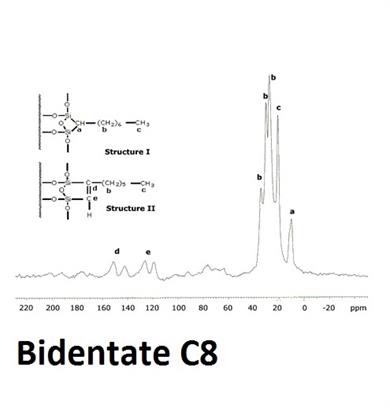
Solid-state CP-MAS ^13C NMR spectrum of a Cogent Bidentate C8™ stationary phase showing assignments for the various carbon environments associated with the bonded ligand structure.
Interpretation of the Spectrum
The observed carbon resonances correspond to the various carbon groups present within the bonded ligand. The signal assignments help confirm:
- Presence of the C8 hydrocarbon chain
- Expected ligand structure
- Surface attachment chemistry
- Bonded phase composition
By comparing the observed resonances with the expected carbon environments, the ligand structure can be verified.
Evidence of Bidentate Attachment
One of the most significant observations from the NMR data is evidence supporting the: Bidentate ligand attachment characteristic of Cogent stationary phases.
In this bonding arrangement:
- The ligand is attached at two points to the silica hydride surface.
- The resulting structure differs from conventional single-point attachment approaches.
- A highly stable bonded phase architecture is produced.
This type of attachment is a distinguishing characteristic of Cogent TYPE-C™ Silica technology.
Comparison to Conventional Silica Phases
Traditional silica-based bonded phases are generally prepared using surface silanol chemistry and often employ different attachment mechanisms than those used with silica hydride materials.
The Cogent Bidentate C8™ structure is notable because:
- It utilizes silica hydride technology.
- It contains direct silicon-carbon bonds.
- It exhibits bidentate ligand attachment.
- The bonding architecture differs from conventional silica stationary phases.
These differences contribute to the unique properties of the stationary phase.
Importance of Structural Verification
Characterizing the bonded phase structure helps support:
- Product development
- Manufacturing consistency
- Stationary phase verification
- Surface chemistry confirmation
- Understanding of chromatographic behavior
Structural characterization techniques such as solid-state NMR provide valuable insight into the composition and architecture of bonded stationary phases.
Conclusion
Solid-state CP-MAS ^13C NMR spectroscopy provides structural confirmation of the Cogent Bidentate C8™ stationary phase and helps verify the unique ligand attachment chemistry associated with Cogent TYPE-C™ Silica technology. The resulting spectrum supports the presence of the expected carbon environments and highlights the distinctive bidentate bonding architecture that differentiates these phases from conventional silica-based stationary phases.