
Date: 25-NOVEMBER-2013 Last Updated: 25-AUGUST-2026
Introduction
When a compound exhibits little or no retention in a HILIC method, it is tempting to assume there is a problem with the column or the mobile phase. However, retention is fundamentally determined by the chemical properties of the analyte itself.
One compound that frequently raises questions is triphenylamine. Although it contains a nitrogen atom, its chromatographic behavior can differ significantly from many other amines because its structure is dominated by three large aromatic phenyl groups attached to a tertiary amine center.
Understanding the relationship between molecular structure and retention can help explain why triphenylamine often exhibits weaker retention than many analysts expect.
Structure of Triphenylamine
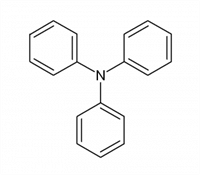
.
Why Retention May Be Lower Than Expected
Retention in HILIC methods is generally strongest for compounds that exhibit:
- High polarity
- Strong ionization
- Significant interaction with the stationary phase
- Extensive hydrophilic character
Triphenylamine differs from many commonly retained polar analytes because much of its molecular structure consists of hydrophobic aromatic groups.
As a result:
- Overall polarity is reduced.
- Hydrophilic interactions may be weaker.
- Retention may be lower than expected.
This behavior is often normal and does not necessarily indicate a problem with the chromatographic system.
The Influence of the Tertiary Amine
Amines are frequently analyzed using HILIC methods because many amine-containing compounds are highly polar and readily ionized. However, not all amines behave the same.
Triphenylamine contains a:
Tertiary amine
In general:
- Primary amines are often more polar.
- Secondary amines are moderately polar.
- Tertiary amines frequently exhibit lower effective polarity than comparable primary or secondary amines.
This difference can significantly affect retention.
Steric Effects and Molecular Shape
The large phenyl groups surrounding the nitrogen atom can also influence chromatographic interactions. The molecular structure creates substantial steric bulk around the tertiary amine center.
Potential consequences include:
- Reduced accessibility of the nitrogen atom
- Reduced interaction with the stationary phase
- Altered selectivity
- Lower than anticipated retention
In some cases, these steric effects may contribute as much to retention behavior as polarity itself.
Aromatic Character Versus Polar Character
Although triphenylamine contains a nitrogen atom, the molecule is largely dominated by:
- Aromatic rings
- Hydrophobic surface area
- Non-polar molecular regions
Consequently, chromatographic behavior may be influenced more strongly by its hydrophobic character than by the presence of the amine functionality. This often results in retention patterns that differ substantially from those of smaller or more polar amines.
Comparing Primary, Secondary, and Tertiary Amines
A useful general guideline for HILIC method development is:
Primary Amines
Typically exhibit:
- Higher polarity
- Stronger retention
- Greater responsiveness to ionization control
Secondary Amines
Often demonstrate:
- Intermediate retention
- Moderate polarity
Tertiary Amines
Frequently exhibit:
- Lower polarity
- Reduced retention
- Greater influence from steric effects
Triphenylamine exemplifies this trend because of its highly substituted tertiary amine structure.
Method Development Considerations
If retention of triphenylamine is insufficient, potential optimization strategies include:
Evaluate Mobile Phase Composition
Adjust:
- Organic solvent content
- Water percentage
- Additive concentration
Evaluate Ionization Conditions
Retention may improve when ionization conditions are optimized.
Review:
- Mobile phase pH
- Acid concentration
- Buffer selection
Consider Alternative Selectivity
Phenyl-containing compounds sometimes respond differently to alternative stationary phases. Evaluating complementary selectivities may improve chromatographic performance.
Interpreting Low Retention
Low retention of triphenylamine should not automatically be viewed as a method failure.
Instead, it often reflects:
- The hydrophobic character of the molecule
- The tertiary amine structure
- Steric crowding around the nitrogen atom
- Limited polarity compared with other amines
These structural attributes frequently explain the observed chromatographic behavior.
Key Takeaways
- Triphenylamine may exhibit lower retention than expected in HILIC methods.
- The molecule contains three large phenyl groups that contribute substantial hydrophobic character.
- Steric hindrance around the tertiary amine can reduce interactions with the stationary phase.
- Tertiary amines are generally less polar than comparable primary or secondary amines.
- Retention of triphenylamine is often influenced more by molecular structure than simply by the presence of a nitrogen atom.
- Low retention is not necessarily indicative of a column or method problem.
- Understanding analyte structure is essential for successful HILIC method development.
