
Phenolic Compounds Separated on Phenyl Hydride with LCMS - AppNote
February 25, 2014
/
/
/
Date: 25-FEBRUARY-2014 Last Update: 15-AUGUST-2026
Commercial Rice Extract Analyzed Easily.A commercial rice extract was analyzed and peaks were assigned based on retention times and m/z values for the compounds of interest using the Cogent Phenyl Hydride Column . After method validation the developed procedure can be used to evaluate the quality of rice and to develop the best extraction procedure.
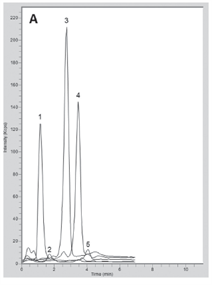
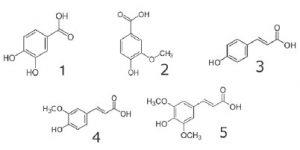
Peaks:
1. 3,4-Hydroxybenzoic Acid
153 m/z [M-H]–
2. Vanillic Acid
167 m/z [M-H]–
3. p-Coumaric Acid
163 m/z [M-H]–
4. Ferulic Acid
193 m/z [M-H]–
5. 3,5-Dimethoxy-4-Hydroxycinnamic Acid
223 m/z [M-H]–
Column: Cogent Phenyl Hydride™, 4 µm, 100 Å
Catalog No.: 69020-05P-2
Dimensions: 2.1 x 50 mm
Mobile Phase:
- A: DI Water / 0.1% Formic Acid (v/v)
- B: Acetonitrile / 0.1% Formic Acid (v/v)
Gradient:
| Time (minutes) | %B |
|---|---|
| 0 | 10 |
| 5 | 20 |
| 6 | 20 |
| 7 | 10 |
Post Time: 3 minutes
Injection vol.: 1 µL
Flow rate: 0.4 mL / minute
Detection: ESI – NEG - PerkinElmer Flexar SQ 300 Mass Spectrometer
Samples:
- Figure A: Commercial rice extract was analyzed.
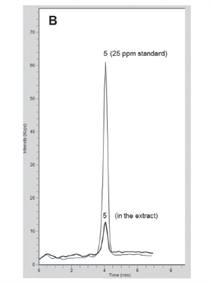
- Figure B: Peak of 3,5-Dimethoxy-4-Hydroxycinnamic Acid in commercial rice extract overlaid with the peak for 25 ppm standard.
Note: Rice is a staple food in many countries. It contains phenolic compounds which have anticancer, antioxidant, and antimutagenic effects. It is important to analyze rice extracts to confirm the content of the phenolic compounds in rice.
