
Date: 16-APR-2026 Last Updated: 17-APR-2026
An Analysis of Sugars Found in Energy Drinks
This application note demonstrates a single HPLC–ELSD method for the simultaneous separation and detection of polar compounds typically found in energy drink formulations, eliminating the need for derivatization. This method is simple, robust, and well suited for routine quality control and formulation verification.

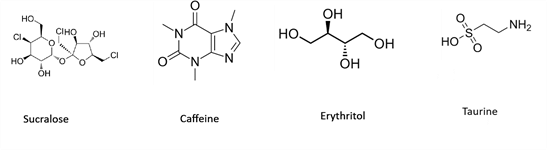
Peaks:
1. Sucralose
2. Caffeine
3. Erythritol
4. Taurine
Method Conditions
Column: Cogent Diamond Hydride™, 4 µm, 100 Å
Catalog No.: 70000-10P
Dimensions: 4.6 x 100 mm
Mobile Phase: 90% Acetonitrile 10% DI Water + 0.1% Formic Acid
Flow Rate: 1.0mL / minute
Injection Volume: 3uL
Detection:
ELSD
(Evaporative Light Scattering Detector)
Gain: 8; Temperature: 50°C;
Sample Preparation:
Stock solutions
-
Sucralose: 1.0 mg/mL
-
Caffeine: 1.0 mg/mL
-
Erythritol: 1.0 mg/mL
-
Taurine: 1.0 mg/mL
Volumes used for working solution
-
Sucralose: 125 µL
-
Caffeine: 250 µL
-
Erythritol: 250 µL
-
Taurine: 250 µL
|
Compound |
Final Concentration (mg/mL) |
|---|---|
|
Sucralose |
0.143 mg/mL |
|
Caffeine |
0.286 mg/mL |
|
Erythritol |
0.286 mg/mL |
|
Taurine |
0.286 mg/mL |
t0: 1.17 minutes
Note: Taurine is named after the Latin word taurus (bull) as it was first isolated from ox bile in 1827 by German scientists Friedrich Tiedemann and Leopold Gmelin.
