
IMP, IDP and ITP Inosine Nucleotides Analyzed by HPLC - AppNote
July 5, 2013
/
/
/
/
IMP, IDP, and ITP Analyzed by HPLC
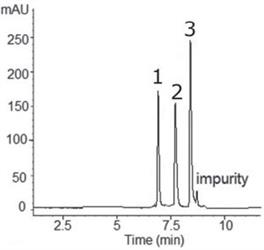
The figure shows the optimized separation of ITP ( Inosine 5’-monophosphate) , IDP ( Inosine 5’-diphosphate) and IMP ( Inosine 5’-triphosphate) in the order of increasing Phosphate content similar to anion exchange. The presence of at least one impurity near ITP and possibly a second near IMP precluded accurate determination of peak symmetry.
Column: Cogent UDA™, 4 µm, 100 Å
Catalog No.: 40031-05P-2
Dimensions: 2.1 x 50 mm
Mobile Phase:
-- A: DI Water / 16.0mM Ammonium Formate
-- B: 90% Acetonitrile / 10% DI Water / 16.0mM Ammonium Acetate
Gradient:
Temperature: 25˚C
Post Time: 3 minutes
Injection vol.: 1 μL
Flow rate: 0.4 mL / minute
Detection: UV @ 254 nm
Sample Preparation: Stock Solution: 1 mg / mL solutions in DI Water. Samples were diluted 1:10 into 50% Acetonitrile / 50% DI Water mixture. Before injection, samples were filtered through a 0.45 µm Nylon Syringe Filter (MICROSOLV Tech Corp).
t 0 : 0.7 minutes
Note: Deficiency of the enzyme ITP Pyrophosphohydrolase is a common genetic defect in human populations and has aroused recent interest for its putative pharmacogenetic relevance to Thiopurine therapy. The enzyme is part of a nucleotide ‘‘futile cycle’’, which converts IMP to IDP and ITP then back to IMP.

Attachment No 261 Separation of Inosine Nucleotides pdf 0.2 Mb Download File
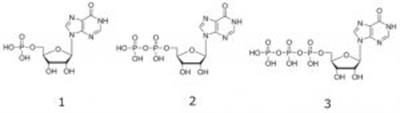
The figure shows the optimized separation of ITP ( Inosine 5’-monophosphate) , IDP ( Inosine 5’-diphosphate) and IMP ( Inosine 5’-triphosphate) in the order of increasing Phosphate content similar to anion exchange. The presence of at least one impurity near ITP and possibly a second near IMP precluded accurate determination of peak symmetry.
Peaks:
1. IMP – Inosine 5’-monophosphate,
2. IDP – Inosine 5’-diphosphate,
3. ITP – Inosine 5’-triphosphate
Column: Cogent UDA™, 4 µm, 100 Å
Catalog No.: 40031-05P-2
Dimensions: 2.1 x 50 mm
Mobile Phase:
-- A: DI Water / 16.0mM Ammonium Formate
-- B: 90% Acetonitrile / 10% DI Water / 16.0mM Ammonium Acetate
Gradient:
| Time (minutes) | %B |
|---|---|
| 0 | 100 |
| 1.5 | 100 |
| 13 | 30 |
| 20 | 30 |
| 20.1 | 100 |
Temperature: 25˚C
Post Time: 3 minutes
Injection vol.: 1 μL
Flow rate: 0.4 mL / minute
Detection: UV @ 254 nm
Sample Preparation: Stock Solution: 1 mg / mL solutions in DI Water. Samples were diluted 1:10 into 50% Acetonitrile / 50% DI Water mixture. Before injection, samples were filtered through a 0.45 µm Nylon Syringe Filter (MICROSOLV Tech Corp).
t 0 : 0.7 minutes
Note: Deficiency of the enzyme ITP Pyrophosphohydrolase is a common genetic defect in human populations and has aroused recent interest for its putative pharmacogenetic relevance to Thiopurine therapy. The enzyme is part of a nucleotide ‘‘futile cycle’’, which converts IMP to IDP and ITP then back to IMP.
Attachment No 261 Separation of Inosine Nucleotides pdf 0.2 Mb Download File