Date: 16-OCTOBER-2020 Last Updated: 25-AUGUST-2026
Introduction
When chromatographic performance suddenly deteriorates, it is common to assume that the HPLC column is the source of the problem. However, experienced chromatographers know that many retention, peak shape, baseline, and reproducibility issues originate elsewhere in the analytical system.
Before replacing a column or beginning extensive column troubleshooting, it is often more effective to systematically evaluate the mobile phase, instrument configuration, method parameters, sample preparation procedures, and injection system. A structured troubleshooting approach can save significant time while avoiding unnecessary column replacement.
Common Causes of Poor Chromatographic Results
Many chromatographic problems that appear to be column-related are actually caused by issues elsewhere in the workflow.
Potential sources include:
- Mobile phase preparation errors
- Incorrect gradient delivery
- Solvent line problems
- Pump calibration issues
- Method changes
- Sample preparation errors
- Injection system malfunctions
- Detector settings
For this reason, a complete system review should be performed before concluding that the column is damaged or contaminated.
Evaluate the Mobile Phase First
Mobile phase problems are among the most common causes of poor chromatographic performance.
Review the following:
Solvent Preparation
Verify:
- Mobile phases were prepared correctly.
- Solvent compositions match the method.
- Additives were measured accurately.
- Fresh solvents were used when required.
Solvent Line Connections
Confirm:
- Solvent A and Solvent B reservoirs are correctly assigned.
- Tubing connections are properly installed.
- No solvent lines have been interchanged.
Pump Delivery Accuracy
Evaluate:
- Flow-rate calibration
- Pump performance
- Proportioning valve operation
- Gradient accuracy
Even small delivery errors can produce significant retention and selectivity changes.
Verify the Method Parameters
Unexpected chromatographic changes may sometimes result from method settings rather than hardware issues.
Review:
- Mobile phase composition
- Gradient profile
- Flow rate
- Column temperature
- Detector wavelength
- Injection volume
- Data acquisition settings
In multi-user laboratories, method modifications can occasionally occur without being immediately recognized.
Review Sample Preparation Procedures
Sample-preparation issues can often mimic column problems.
Potential concerns include:
- Incorrect analyte concentration
- Sample degradation
- Incomplete extraction
- Filtration errors
- Matrix effects
- Recovery issues
If analyte recovery is uncertain, verify sample preparation before investigating the chromatographic system.
Inspect the Injector
Injection-related problems can produce inconsistent results that may be mistaken for column failure.
Important checks include:
- Proper syringe operation
- Needle positioning
- Injection-volume accuracy
- Sample aspiration performance
- Carryover evaluation
Small-volume injections are particularly sensitive to injector performance issues.
Case Study: Investigating Retention Drift
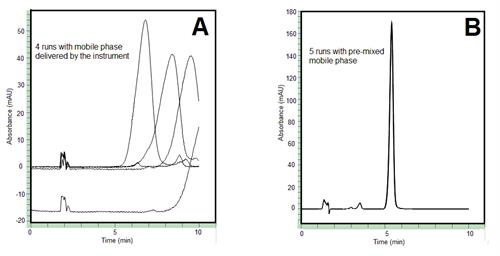
A useful example involved the analysis of ethylbenzene using a Cogent™ UDA™ column.
During routine analysis, chromatograms began exhibiting:
- Increasing retention times
- Broadening peaks
- Reduced retention precision
At first glance, these symptoms appeared consistent with a column problem.
However, because the stationary phase had a history of stable performance, other possibilities were investigated before troubleshooting the column.
Identifying the Actual Problem
The method used:
- A 0.5 mL/min isocratic flow rate
- Two solvent reservoirs
- Approximately 70:30 mobile phase composition
To eliminate potential mixing issues, a premixed mobile phase was prepared and delivered from a single reservoir.
After switching to the premixed solvent:
- Retention-time precision improved.
- Peak efficiency improved.
- Chromatographic performance returned to normal.
This demonstrated that the column was functioning properly.
The source of the problem was ultimately traced to the solvent delivery system, likely involving:
- Solvent B delivery
- Gradient mixing
- Proportioning valve performance
Additional Example: Injector Performance
A second issue involved intermittent detection of a minor chromatographic peak. Investigation showed that the problem was not related to the column.
The method used a:
1 µL injection volume
After increasing the injection volume to:
5 µL
the peak became consistently detectable.
This confirmed that the issue originated from injection performance and method sensitivity rather than column behavior.
Chromatogram Comparison
Recommended Troubleshooting Workflow
Before suspecting the column:
Check the Mobile Phase
- Solvent identity
- Additive concentration
- Preparation accuracy
- Age of the solvent
Verify Instrument Performance
- Flow rate
- Pump calibration
- Gradient accuracy
- Solvent delivery
Confirm Method Settings
- Gradient profile
- Detection wavelength
- Injection volume
- Data acquisition parameters
Evaluate Sample Preparation
- Recovery
- Concentration
- Filtration
- Stability
Inspect the Injector
- Needle function
- Syringe operation
- Injection precision
Only after these factors have been ruled out should extensive column troubleshooting begin.
Key Takeaways
- Poor chromatographic performance is frequently caused by system-related issues rather than column failure.
- Mobile phase preparation and solvent delivery should be verified first.
- Method settings should always be reviewed before replacing a column.
- Sample preparation and injector performance can significantly affect chromatographic results.
- Premixed mobile phases can be useful diagnostic tools when solvent-delivery problems are suspected.
- Systematic troubleshooting often identifies the problem faster than immediately focusing on the column.
- A stable, reproducible column can appear faulty when other HPLC system components are malfunctioning.