
Overview
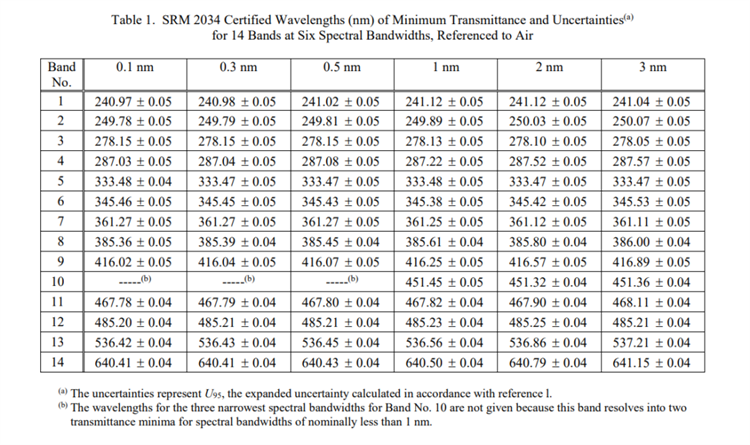
Holmium Oxide wavelength calibration standards are commonly used to verify wavelength accuracy in UV-Vis spectrophotometers and qualification programs. Published reference values are often provided for specific instrument bandwidths, but situations may arise where an instrument operates at a bandwidth that does not exactly match the available reference data.
When this occurs, appropriate reference values can still be established using accepted approximation methods.
Using Interpolation Between Published Values
Interpolation is often the preferred approach when a bandwidth falls between two published reference values. This method estimates the expected value by calculating a point between known reference values.
Benefits of interpolation include:
- Improved precision
- Better alignment with instrument settings
- Consistent qualification methodology
- Scientifically supported estimation
Many laboratories routinely use interpolation when exact reference values are unavailable.
Using the Next Higher Published Value
A practical alternative is to use the next higher published reference value. This approach is often acceptable because differences between adjacent reference values are typically very small.
In many cases:
- Differences occur only in the third or fourth significant figure.
- The variation is smaller than the wavelength accuracy capability of many instruments.
- The impact on routine qualification results is negligible.
For many qualification activities, this approach provides a practical and efficient solution.
Considerations for Instrument Accuracy
When selecting an alternate reference value, the instrument's wavelength accuracy specification should be considered. Many UV-Vis instruments operate within a wavelength accuracy range that is significantly larger than the small differences observed between adjacent Holmium Oxide reference values.
Because of this relationship, either interpolation or use of the next higher value will generally provide suitable qualification guidance when an exact reference value is not available.
Reference Conditions
The published qualification data referenced for Holmium Oxide standards were established using:
- Cell Path Length: 1.0 cm
- Reference Material: Water
Consistency in these conditions helps ensure reliable comparison to published qualification values.
Best Practices
When using alternate reference values:
- Follow established laboratory qualification procedures.
- Apply the selected approach consistently.
- Document any interpolation calculations.
- Verify reference conditions match the qualification procedure.
- Retain supporting qualification documentation.
Consistent methodology helps improve reproducibility and audit readiness.
Key Takeaways
- Exact bandwidth reference values may not always be available.
- Interpolation can be used to estimate values between published bandwidths.
- Using the next higher published value is often an acceptable alternative.
- Differences between adjacent values are typically very small.
- Instrument wavelength accuracy should be considered when selecting reference values.
- Both approaches can support reliable Holmium Oxide wavelength qualification activities.