
DATE: 27-JUNE-2025 Last Updated: 4-SEPTEMBER-2026
Wavelength Calibration
When working with spectrophotometers that use mechanical monochromators (devices that select specific wavelengths of light), it's important to check how precisely the instrument can return to a chosen wavelength—this is called wavelength precision or reset capability.
Here’s how the Wavelength Precision Tests (resettability) test is done in our UV-vis Software:
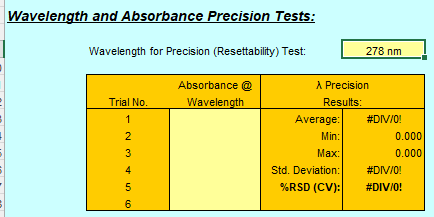
- Set the wavelength: The wavelength resettability can be performed at any nominal wavelength that the user chooses. In the example, it is set at 278 nm.
- Read the absorbance value.
- Change the wavelength setting to several nm above or below the nominal wavelength, then return to the nominal wavelength.
- Read the absorbance value.
- Repeat this six times (do three readings above, and three below the nominal wavelength, alternating).
- The Standard Deviation (SD) and Coefficient of Variation (CV) are calculated from those absorbance values—this tells you how consistent and precise the instrument is at resetting the same wavelength.
Absorbance precision, as shown in the right-hand table, involves removing and reinserting the cuvette six times, with absorbance measured after each insertion.
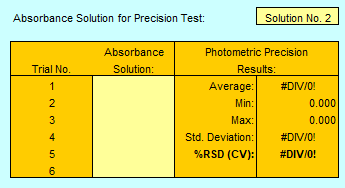
It’s important to note that the two tables represent separate measurements and are not directly related.