
Tandem LC‑MS Approach to Metabolite Profiling: Sequential RP + HILIC Separation for Comprehensive Coverage
Metabolite profiling often requires analyzing molecules with dramatically different physicochemical properties. Traditional single‑mode LC methods struggle to detect both hydrophilic and hydrophobic components in the same run.
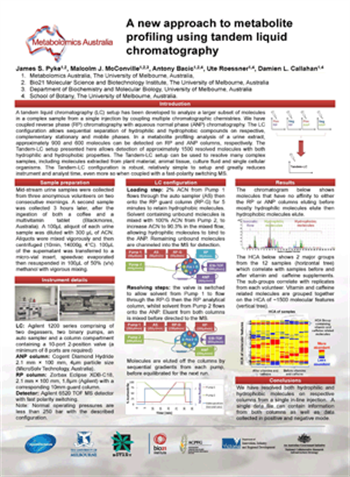
The tandem LC‑MS approach described here overcomes this limitation by combining Reversed Phase (RP) and HILIC chromatography in a single in‑line setup, enabling broad analyte coverage from one injection.
Why Use a Tandem LC Configuration?
A single injection into a tandem LC system allows the sample to pass sequentially through two complementary chromatographic chemistries:
1. Reversed Phase (RP) Column
Ideal for non‑polar to moderately polar metabolites.
Approx. 900 molecules detected in urine extract under RP conditions.
2. HILIC Column
Designed for highly polar and ionic metabolites.
Approx. 600 molecules detected on HILIC columns in the same extract.
Together, the combined system can detect ~1500 resolved molecules—dramatically improving metabolome coverage compared to conventional, single‑mode LC‑MS.
How the Tandem LC System Works
The system is designed so that both columns operate in sequence during a single continuous run:
-
Hydrophilic compounds are retained primarily on the HILIC column.
-
Hydrophobic compounds are retained on the RP column.
-
After passing through both phases, the eluent enters the mass spectrometer, where data is collected in both positive and negative ionization modes.
This pairing maximizes detection breadth while maintaining robust chromatographic resolution for chemically diverse species.
Key Advantages of Tandem LC‑MS for Metabolomics
1. Dual Chemistry = Maximal Coverage
By combining RP and HILIC selectivities, the method captures a broader molecular spectrum, including plant metabolites, animal tissue extracts, culture media components, and single‑cell organism metabolites.
2. Single Injection Efficiency
Instead of running multiple methods, the system produces all necessary chromatographic data in one file—reducing analyst time and reducing instrument usage significantly.
3. Straightforward Setup
Despite offering multi‑mode separations, the system is described as robust and relatively simple to implement, especially when paired with fast polarity‑switching MS instruments.
4. Comprehensive Data in One File
Both hydrophilic and hydrophobic chromatographic data, plus positive and negative mode MS scans, are stored in a single output file—streamlining review and processing.
Conclusion
The tandem LC‑MS approach enables highly efficient, wide‑spectrum metabolite profiling. By coupling RP and HILIC in a single in‑line configuration, analysts can detect roughly 1500 metabolites from one sample injection—representing a dramatic improvement over single‑mode LC methods.
This makes the technique particularly valuable for complex biological samples and high‑throughput metabolomics applications.
Attachment Tandem LCMS Single Line Injection Poster pdf Download File